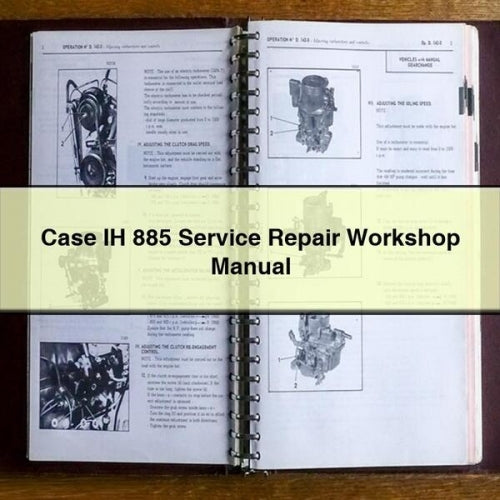
Target Audience:
DIY owners with basic mechanical skills and independent service professionals
Manual Positioning:
Complete factory service manual used by dealer technicians
Cost Savings:
Save hundreds to thousands in repair bills by doing repairs yourself
Comprehensiveness:
Same specifications and procedures as authorized dealer service department
Content Format:
Step-by-step instructions, diagrams, illustrations, wiring schematics, and specifications
Practicality:
Printable pages; avoid oil-stained paper originals
Engine:
Complete engine disassembly, inspection, and repair procedures
Transmission:
Transmission and drivetrain service and repair
Hydraulics:
Hydraulic system troubleshooting and overhaul
Electrical:
Wiring diagrams and electrical component testing
Steering and Brakes:
Service and adjustment procedures
Cooling System:
Radiator, water pump, and thermostat service
Fuel System:
Fuel injection pump and injector service (if applicable)
Exhaust System:
Troubleshooting and replacement
Power Take-Off (PTO):
Clutch adjustment and overhaul
Final Drive and Axle:
Service and rebuild procedures
Cab and Controls:
Air conditioning, gauges, and operator controls
Maintenance:
Scheduled service procedures
Lubrication:
Oil and grease points with capacities
Adjustments:
Valve lash, clutch, brakes, and others
Disassembly and Reassembly:
Step-by-step instructions for major components
Level:
Factory-level detail used by dealer technicians
Diagrams and Illustrations:
Detailed illustrations and wiring schematics for clarity
Specifications:
Torque, clearances, and tolerances
Parts Diagrams:
Exploded views for parts identification (implied by manual content)
Part Numbers:
OEM reference numbers, where applicable
File Type:
PDF (Portable Document Format)
Compatibility:
Works on PCs, Macs, many phones, and e-readers like Kindle
Requirements:
Adobe PDF Reader or similar
Searchability:
Digital text allows for search and navigation (assumed)
Print Quality:
N/A - digital product; user may print at desired quality
Binding Type:
Digital (electronic file)
Paper Type:
N/A - no physical paper included
Primary Engine:
Case IH 4-cylinder diesel (specific model not detailed in manual)
Engine Range:
Various displacement options depending on year/region
Horsepower:
Approximately 80-90 PTO HP (specific not confirmed)
Torque:
N/A - not specified in manual
Injection:
Direct injection (assumed for era)
Capacity:
Not specified in manual
Wheelbase:
Approximately 2300 mm (90.5 in) (not given in manual)
Length:
Approximately 4000 mm (158 in) (not given in manual)
Curb Weight:
Approximately 3,600 kg (7,900 lb) (not given in manual)
Ballast:
Front weights available for balance
Ratings:
N/A - agricultural tractor; no crash test ratings exist
Brakes:
Wet disc brakes standard
Steering:
Power steering option available
Rollover Protection:
ROPS cab or frame (dealer-installed option or factory)
Seat Belt:
Available, depending on configuration
Engine Oil:
Every 100 hours or annually (typical recommended)
Hydraulic Oil:
Every 1000 hours or annually (typical)
Coolant:
Every 2 years or 2000 hours (typical)
Transmission Oil:
Every 1000 hours (typical)
Engine Oil:
API CJ-4 or higher, SAE 15W-40 (typical)
Hydraulic Fluid:
Case IH Hy-Tran Ultra or equivalent (typical)
Coolant:
Ethylene glycol based with SCAs (typical)
Common Wear:
Injector nozzles, water pump seals, steering cylinder seals
Maintenance Alerts:
Check belt tension and clutch adjustment periodically
Brand Heritage:
Case IH formed by merger of J.I. Case and International Harvester in 1985
Model Lineage:
885 was part of the 85 series, succeeding earlier 84 series
Production Span:
Produced from 1980 until late 1980s
Factories:
Built in Doncaster, UK and/or Neuss, Germany (depending on plant)